Almost all residential and commercial elevators in China (as well as elevator lobbies) have small monitors that broadcast, almost 24 hours a day, annoying video ads. Here is a clip:
http://www.youtube.com/watch?v=BoG5LSCawfk
To me, this says a lot about Chinese culture. I am sure most people in the West would not accept such invasions of privacy.
However, more and more Chinese are indicating to me that they are finding these LCD monitors annoying as they proliferate to each and every aspect of Chinese life - elevators, buses, trains, taxis, super markets, etc.
Wednesday, June 7, 2006


Sunday, June 4, 2006
Amusing pirated DVD covers in China

Pirated DVDs are still on sale ubiquitously on the streets (and in shops) in China. Of interest are the covers of the DVDs which often have rather poor or amusingly incorrect English.
Witness the cover of this collection of 24 episodes:
Wednesday, May 31, 2006
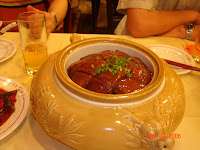
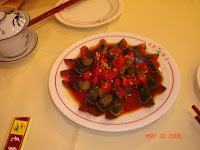
Hunanese Cuisine (湘菜) + Beer = Crazy Delicious
China is chockablock with restaurants serving delicious, spicy and greasy Hunanese cuisine. The food is very good but spicy. Furthermore, since Chairman Mao was from Hunan, often eateries have a Red Guard, Cultural Revolution or Maoist motif. Below are shots from a Hunan restaurant in Zhuhai, Guangdong Province:



Tuesday, May 30, 2006
How would you like that stir fried?
Waitress in Zhuhai, Guangdong Province, China discussing the methods for stir frying the ordered vegetables. At a Hunanese cuisine restaurant.
Tea kung fu
A tea master pours tea out of a long-spouted kettle. It's a sort of herb and flower-ladden tea mix. This was taken in Zhuhai, Guangdong Province, China. In an Hunanese restaurant.
Monday, May 29, 2006


Wednesday, March 1, 2006
Breathe the air in southern China - lose 3 weeks of life over the next 5 years
香港大学研究员发布: 未来5年呼吸香港的空气就失去150,000“人生年”。 平均每人失去3个星期人生。
http://totallyhk.scmp.com/thkarts/health/ZZZN97TH8JE.html
http://totallyhk.scmp.com/thkarts/health/ZZZN97TH8JE.html
By Robin Kwong
Delays in combating air pollution can be deadly, sometimes literally so. By the most optimistic projections, Hong Kong's air quality won't significantly improve until 2010, the deadline set by the government for local power companies to meet emission reduction targets.
Likewise, while several large-scale power plants, fuelled by relatively cleaner liquefied natural gas, are to be commissioned in Guangdong by mid 2007, how much less coal and oil will be burnt as a result depends on energy demand in the province.
In the meantime, Hong Kong will still be paying the costs. But how much will air pollution cost us in these intervening five years?
At the South China Morning Post's request, the University of Hong Kong's department of community medicine has worked out a rough estimate of life years lost as a result of the wait.
"We have estimated the effect if we could remove all air pollution right now compared with if we removed it in five years - that is, what is the difference caused by the delay," said the department's Dr Sarah McGhee.
Measuring just the impact on mortality rates for people aged 40 and above, Professor McGhee said the cost amounted to 150,000 life years, or about three weeks per person. This was a conservative estimate, partly because it did not take into account the impact on younger people.
Life years, moreover, may be just the tip of the iceberg in cost evaluation, because it does not factor in ill health and loss to quality of life. "We can't estimate all of this effect yet, but we know it must be substantial," she said.
"Since we will not remove all air pollution, we would only save some proportion of that effect in real life, but it gives us an idea of what we might aim for eventually."
Subscribe to:
Posts (Atom)


